Understanding Meniscus Tears
The meniscus, a C-shaped piece of cartilage, acts as a shock absorber between your thigh bone (femur) and shin bone (tibia) in the knee. Each knee has two menisci: the medial (inner) and lateral (outer). These crucial structures help stabilize the knee joint, distribute weight evenly, and facilitate smooth movement. A meniscus tear occurs when this cartilage is damaged, often due to twisting, pivoting, or direct impact.
Common Causes of Meniscus Tears
Meniscus tears can arise from various scenarios. In younger, more active individuals, they often result from sports-related injuries involving sudden stops, turns, or deep squats. Activities like soccer, basketball, and skiing are frequently associated with traumatic meniscus tears. For older adults, the meniscus can weaken and become more brittle with age, making it susceptible to tears from less forceful movements, such as simply getting up from a chair or stepping off a curb. Degenerative tears are common in individuals with osteoarthritis. Direct trauma to the knee, such as a fall or car accident, can also cause a meniscus tear.
Recognizing Symptoms and Red Flags
The symptoms of a meniscus tear can vary depending on the size and location of the tear. Common indicators include:
Pain: Often localized along the joint line, which may worsen with activity, twisting, or squatting.
Swelling: The knee may swell, either immediately after the injury or gradually over several hours.
Stiffness: Difficulty bending or straightening the knee fully.
Clicking or Popping Sensation: Some individuals report hearing or feeling a click or pop at the time of injury or during certain movements.
Locking or Catching: A sensation that the knee is catching or getting stuck, often due to a piece of torn cartilage interfering with joint movement.
Instability: A feeling that the knee might give out, particularly when weight-bearing or changing direction.
Red flags that warrant prompt medical evaluation include severe pain that prevents weight-bearing, significant and rapid swelling, inability to fully extend or flex the knee, or signs of infection such as redness, warmth, or fever.
Diagnosis of a Meniscus Tear
Diagnosing a meniscus tear typically involves a thorough physical examination by a healthcare professional. During this exam, the physician will assess your range of motion, observe for swelling, and perform specific tests, such as the McMurray test or Apley's grind test, which involve manipulating the knee to reproduce symptoms. Imaging studies are often used to confirm the diagnosis and assess the extent of the damage. X-rays can rule out bone fractures or other structural issues, although they do not show cartilage. Magnetic Resonance Imaging (MRI) is the most common and effective imaging tool for visualizing the meniscus and identifying tears, as well as assessing other soft tissue structures within the knee.
Physical Therapy: A Cornerstone of Recovery
Whether a meniscus tear is managed conservatively or surgically, physical therapy plays a critical role in recovery. Physical Therapy NOW™ emphasizes individualized care plans designed to restore function, reduce pain, and prevent re-injury.
Conservative Management
For many stable or smaller tears, especially degenerative ones, non-surgical treatment with physical therapy is often the first line of defense. This approach focuses on:
Pain and Swelling Control: Modalities such as ice, compression, and elevation (R.I.C.E.) are used in the acute phase. Gentle, pain-free range of motion exercises help reduce stiffness and improve circulation.
Restoring Range of Motion: Targeted exercises are prescribed to regain full flexion and extension of the knee without aggravating the tear.
Strengthening: A progressive strengthening program focuses on the muscles surrounding the knee, including the quadriceps, hamstrings, and calf muscles, to improve knee stability. Hip and core strengthening are also vital for overall lower extremity control.
Neuromuscular Control and Balance: Exercises to improve proprioception (the body's sense of position) and balance help re-educate the knee and prevent future injuries. Examples include single-leg standing, wobble board exercises, and agility drills.
Return to Activity: As strength and stability improve, physical therapists guide patients through functional exercises relevant to their daily activities, work, or sports, ensuring a safe and gradual return.
Post-Surgical Rehabilitation
If surgery is required (meniscectomy to remove the damaged part, or meniscus repair to stitch it back together), physical therapy is crucial for optimal post-operative outcomes. The rehabilitation protocol will vary significantly depending on the type of surgery:
Phase 1: Initial Protection (Weeks 0-6, variable by surgery type) Focus: Managing pain and swelling, protecting the surgical site, restoring gentle range of motion, and activating muscles without stressing the repair. Weight-bearing restrictions may be in place, especially for repairs. Interventions: Icing, elevation, gentle passive and active-assistive range of motion, quadriceps and hamstring isometric exercises, ankle pumps.
Phase 2: Progressive Loading and Strength (Weeks 6-12, variable) Focus: Gradually increasing weight-bearing (if previously restricted), improving full range of motion, and initiating controlled strengthening. The goal is to build a stable foundation. Interventions: Partial weight-bearing exercises (e.g., mini-squats), closed-chain exercises (e.g., wall slides), light resistance band exercises, stationary cycling, progressive gait training.
Phase 3: Advanced Strengthening and Functional Return (Weeks 12+, variable) Focus: Restoring full strength, power, agility, and sport-specific or activity-specific function. This phase emphasizes high-level neuromuscular control and injury prevention. Interventions: Lunges, step-ups, single-leg squats, plyometric exercises (jumping, hopping), agility drills, sport-specific training, balance training on unstable surfaces.
Realistic Recovery Timelines
Recovery timelines for meniscus tears vary widely. For conservative management, patients may see significant improvement within 6-12 weeks, with a full return to activities potentially taking 3-6 months, depending on the tear and individual factors. For surgical cases, a meniscectomy (removal of torn part) typically involves a quicker recovery, with return to activities in 2-4 months. A meniscus repair, which involves stitching the tear, requires a much longer and more conservative rehabilitation period, often 4-6 months before returning to light activities, and 6-9 months or more for full, unrestricted athletic participation due to the need for the cartilage to heal.
Example Rehab Exercises (Always perform under professional guidance):
Quadriceps Sets: Sit with your leg straight. Press the back of your knee into the floor, tightening your thigh muscle. Hold for 5 seconds. Repeat 10-15 times.
Hamstring Curls: Lie on your stomach. Bend your knee, bringing your heel towards your buttocks. Slowly lower. Repeat 10-15 times.
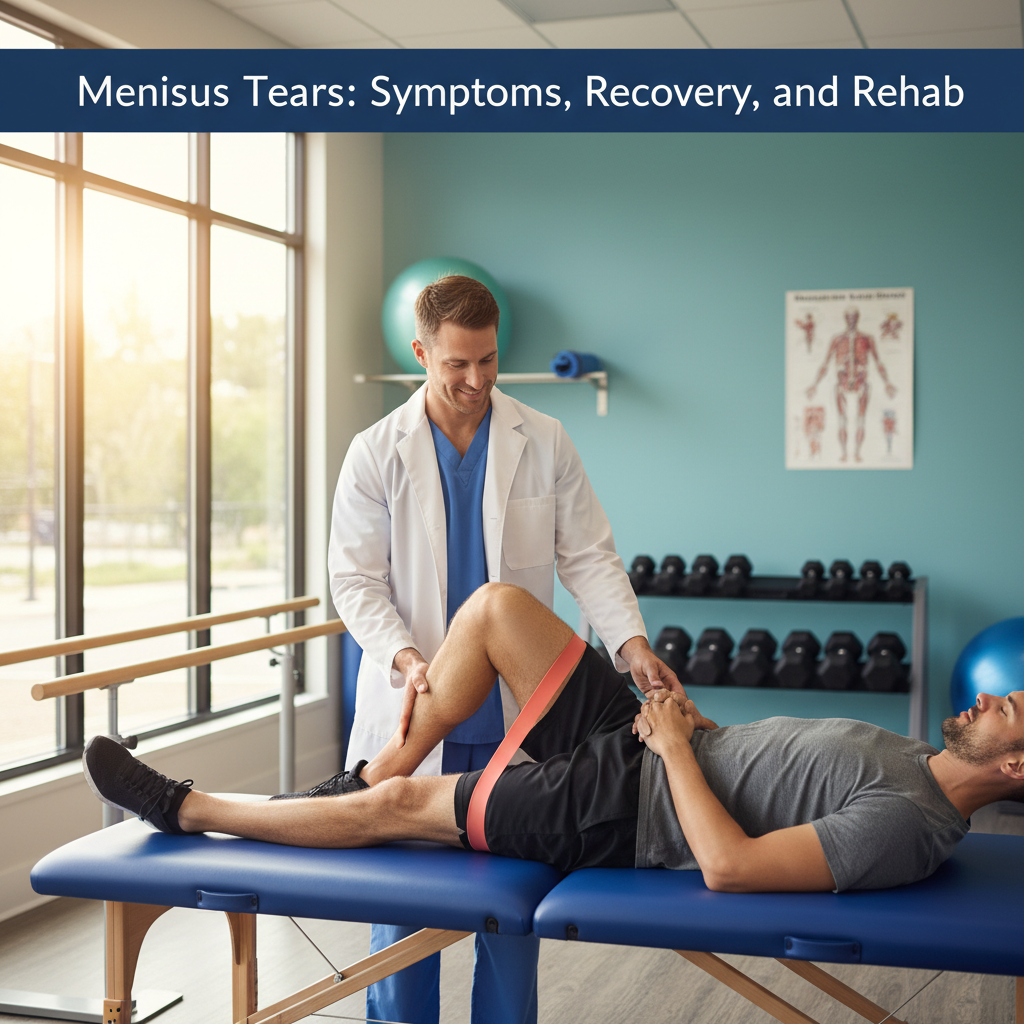
Heel Slides: Lie on your back. Slowly slide your heel towards your buttocks, bending your knee as far as comfortable. Slowly straighten. Repeat 10-15 times.
Calf Raises: Stand with support. Lift your heels off the ground, standing on your toes. Slowly lower. Repeat 10-15 times.
When to Refer / When to Seek Care
Patients: If you experience persistent knee pain, swelling, difficulty moving your knee, or a sensation of catching or locking, it is crucial to consult a healthcare professional. Early diagnosis and intervention can significantly impact recovery outcomes. Do not attempt to self-diagnose or self-treat a suspected meniscus tear without professional guidance.
Physicians: Consider referring to physical therapy for all confirmed meniscus tears, whether managed conservatively or surgically. For conservative cases, physical therapy can prevent the need for surgery. Post-surgically, it is essential for restoring function and preventing complications. Referrals are particularly beneficial when patients present with persistent pain, limited range of motion, muscle weakness, gait deviations, or impaired functional mobility following a suspected or diagnosed meniscus injury. Physical Therapy NOW™ provides comprehensive, evidence-based rehabilitation programs tailored to each patient's specific needs and surgical protocol.
Your Path to Recovery
Navigating a meniscus tear can be challenging, but with the right approach to rehabilitation, a full return to your desired activities is often achievable. Physical therapy is a vital component of this journey, providing the guidance and expertise needed to strengthen your knee, restore mobility, and rebuild confidence. Commit to your rehabilitation program, and you will be well on your way to a healthier, more active life.
Ready to feel better? Physical Therapy NOW™ has 40+ Florida locations, most with same-week appointments and no referral required in most cases.
Schedule now at https://physicaltherapynow.com/schedule · Call 800.481.4582
Ready to start feeling better?
Physical Therapy NOW™ has 40+ Florida locations with same-week appointments. Most insurance, auto accident (PIP), workers' compensation and Medicare accepted.