
Understanding this injury
An AC joint sprain happens at the top of your shoulder where the collarbone (clavicle) meets the highest point of the shoulder blade (acromion). These two bones are held together by strong ligaments. When these ligaments are stretched or torn, usually from a sudden impact, it is often called a shoulder separation. While it sounds scary, this is different from a shoulder dislocation, as the ball-and-socket joint remains in place.
Depending on the severity, you might notice a small bump on the top of your shoulder, swelling, or pain when reaching overhead or across your body. At Physical Therapy Now, we focus on stabilizing this joint and reducing inflammation so you can regain full use of your arm without lasting discomfort. Most AC joint injuries respond exceptionally well to conservative care without the need for invasive procedures.
Common symptoms
- Pain on top of the shoulder
- Swelling and tenderness at the AC joint
- Pain with arm movements across the body
- Visible bump on the shoulder (severe cases)
What causes it
- A direct fall onto the tip of the shoulder
- Falling onto an outstretched hand (FOOSH injury)
- A high-impact blow to the shoulder during contact sports like football or hockey
- Repetitive heavy lifting that puts excessive strain on the AC ligaments
- Workplace accidents, such as falling off a ladder or slippage
- Bicycle or motorcycle accidents where the rider lands on their side
Who's most at risk
- Athletes participating in contact sports like rugby, soccer, or wrestling
- Cyclists and mountain bikers who may experience falls
- Construction workers and manual laborers who work at heights
- Individuals with poor shoulder blade stability or weak rotator cuffs
- Older adults at a higher risk of falls due to balance issues
- Pre-existing stiffness in the mid-back which forces the shoulder to overwork
How we treat it
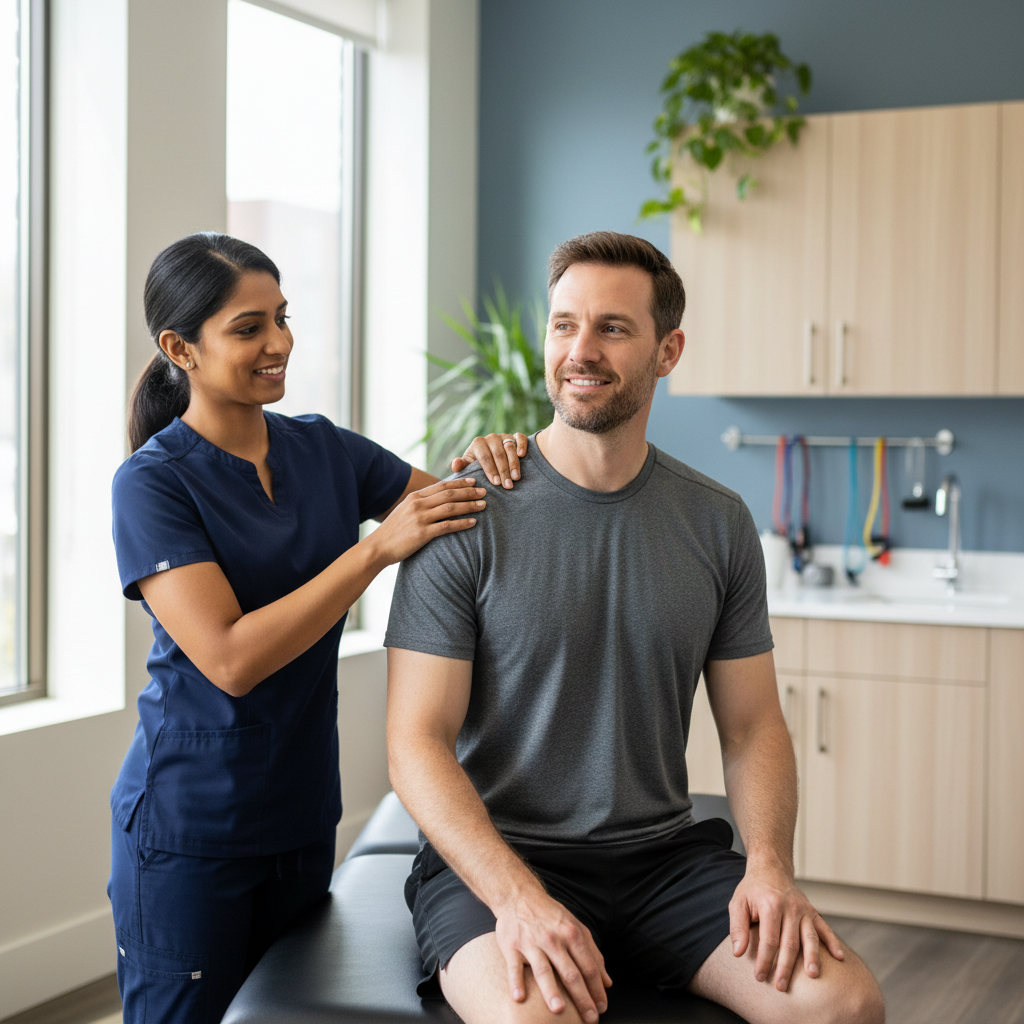
Physical therapy is the gold standard for recovering from an AC joint sprain. When you visit Physical Therapy Now, you will work 1-on-1 with a licensed physical therapist to create a custom recovery plan. In the initial phase, our goal is to reduce pain and protect the healing ligaments. We may use modalities like kinesiology taping to provide external support to the joint, along with gentle cryotherapy or electrical stimulation to manage swelling. Your therapist will also use manual therapy techniques, including gentle joint mobilizations and soft tissue massage, to ensure your shoulder blade is moving correctly without stressing the AC joint.
As your pain subsides, your progression will shift toward strengthening. We focus heavily on the rotator cuff and the muscles surrounding the shoulder blade (scapular stabilizers). Exercises like external rotations, rows, and serratus punches help take the pressure off the collarbone. In the final stages, we incorporate functional movements tailored to your daily life or sport, ensuring you can reach, lift, and push safely. This guided approach ensures you don't return to activity too soon, which could lead to chronic instability or early-onset arthritis in the joint. If your shoulder pain persists for more than 2-3 weeks, is getting worse, or makes it impossible to perform daily tasks, please call us or schedule an appointment online today.
Recovery timeline
Recovery time depends on the grade of your sprain. A mild (Grade I) sprain typically feels better within 2 to 4 weeks with consistent therapy. Moderate sprains (Grade II) may take 6 to 8 weeks as the ligaments require more time to tighten and stabilize. Severe sprains require a more cautious approach, often taking 3 months or more to reach full strength. Throughout every phase, your physical therapist will monitor your progress to ensure the joint is stable enough for increased activity.
What you can do at home today
- Rest the arm in a sling if recommended by your therapist to take the weight off the joint
- Apply ice to the top of the shoulder for 15 minutes several times a day to reduce swelling
- Avoid carrying heavy grocery bags or suitcases on the affected side
- Maintain good posture by pulling your shoulder blades gently back and down
- Avoid reaching across your body or behind your back during the first week
- Sleep on your back or the uninjured side to prevent compression
- Perform gentle pendulums (letting the arm hang and swing) only if pain-free
- Avoid overhead lifting until cleared by your physical therapist
These tips support recovery but don't replace a professional evaluation. If you're unsure or symptoms worsen, please reach out.
When to call us right away
Seek immediate medical attention if you notice a significant, new deformity or 'step-up' bump at the end of your collarbone. You should also seek help if you experience numbness or tingling down your arm, a complete inability to lift your arm, or if your skin appears pale or cold. These signs could indicate a more severe tear or nerve involvement.