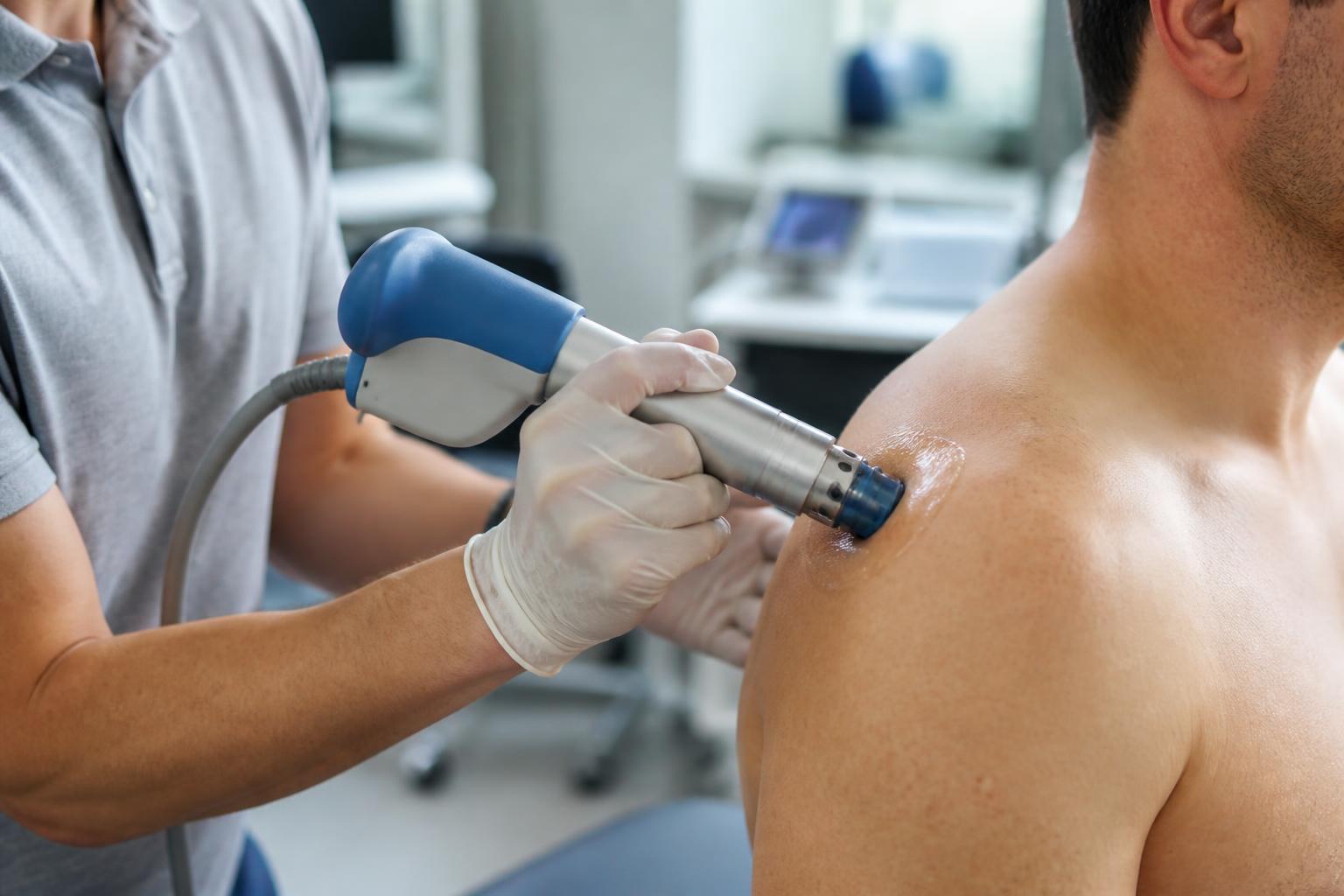
Extracorporeal shockwave therapy (ESWT) has quietly become one of the most useful non-invasive tools in post-accident musculoskeletal care. It is also, right now, one of the most aggressively contested line items on a Florida PIP explanation of benefits. If you are a provider billing CPT code 0101T, the denials hitting your accounts receivable are not random — they are part of a coordinated push by certain carriers, and they are not going away on their own. What Shockwave Therapy Is and Why Providers Use It
ESWT delivers acoustic pressure waves into musculoskeletal tissue to stimulate a healing response. The clinical theory is well established: the mechanical energy promotes neovascularization, modulates inflammatory mediators, breaks up calcific deposits, and accelerates collagen remodeling in tendon and soft tissue.
Peer-reviewed studies in journals such as the American Journal of Sports Medicine and the Journal of Orthopaedic Research support its use for plantar fasciitis, lateral epicondylitis, chronic tendinopathy, and a growing list of post-traumatic soft tissue conditions — exactly the kind of injuries an auto accident produces.
A typical protocol runs three to six sessions spaced about a week apart, with reassessment after the initial series to determine whether additional treatment is justified. It is non-invasive, requires no anesthesia, and for the right patient it can meaningfully reduce reliance on injections and opioids. That is why chiropractors, orthopedists, urgent care centers with sports medicine arms, and even some diagnostic facilities have folded shockwave into their post-accident care pathways. The CPT Code Behind the Fight: 0101T
The CPT code that captures all of this is 0101T, a Category III "emerging technology" code maintained by the AMA. That last word — emerging — is the hook insurers are using to refuse payment, and it is the reason every provider reading this should pay close attention. Why Progressive and Allstate Are Denying CPT 0101T
The argument coming out of Progressive and, increasingly, Allstate is straightforward in structure even if it is wrong on the merits. They take the position that because CPT 0101T has no assigned value on the Medicare Physician Fee Schedule, it is by definition not reimbursable under Medicare, and therefore not reimbursable under Florida''s PIP statute.
They cite the fee schedule limitations in Florida Statute 627.736(5)(a) and argue that an item with no Medicare allowable has nothing to pay. We are seeing this denial language come back almost verbatim on EOBs — "not reimbursable under Medicare Part B" or "no allowable fee on file" — and the AR sitting on provider books is climbing accordingly.
Most other PIP carriers in Florida are still paying CPT 0101T, but the denials are no longer isolated. Sporadic refusals are showing up from carriers who paid the same code six months ago, which suggests the industry is testing the waters. If Progressive and Allstate win this fight in enough county courts, every other carrier will likely follow within a quarter. Common CPT 0101T Denial Language to Watch For • "Not reimbursable under Medicare Part B" • "No allowable fee on file" • "No Medicare fee schedule value" • "Emerging technology" • "No reimbursement due under the applicable fee schedule" • "Service not payable under Florida PIP"
These explanations should not simply be written off. Review them as part of a broader PIP collections strategy, especially if the same language is appearing across multiple patients or carriers. The Provider Counter-Argument Under Florida PIP
The counter-argument, in plain terms: the PIP statute requires payment of reasonable charges for medically necessary services lawfully rendered. The absence of a Medicare-published fee does not make a service non-reimbursable — it simply means the fallback methodology in 627.736(5)(a) controls and a reasonable charge analysis applies.
Florida appellate courts have already addressed analogous Category III code disputes in other contexts, and the prevailing weight of authority supports the providers. But "prevailing weight of authority" is a courtroom phrase. Getting there requires filing suit, surviving motion practice, and putting on competent expert testimony — and that is where many providers lose the war even when they are right on the law. The Peer Review and IME Problem You Cannot Ignore
A second front is opening alongside the Medicare-based denials, and it is more dangerous because it attacks the medical necessity of the treatment rather than the price of the code.
Carriers are commissioning peer reviews that flag shockwave as overutilized: six sessions when three would have sufficed, bilateral treatment when documentation only supports unilateral complaints, or repeated series without an interval reassessment showing measurable improvement. Some of these opinions are written by physicians who have never personally administered ESWT.
Then there is the independent medical examination. In Florida PIP practice, an unfavorable IME does not just adjust future payment for one disputed modality — it can be used to cut off all future medical benefits across every provider treating the patient. Providers have lost six-figure receivables not because their shockwave billing was wrong but because an IME doctor decided the patient had reached maximum medical improvement, and every downstream provider got an across-the-board denial. If shockwave is in the treatment plan and the IME doctor is hostile to it, the entire course of treatment becomes vulnerable in a single afternoon. Why Shockwave Documentation Matters Before Peer Review or IME
Documentation should be built as if it will eventually be reviewed by a hostile carrier, a peer reviewer, an IME physician, and a judge. Strong shockwave records should show: • The patient''s accident-related diagnosis • The conservative care attempted before shockwave • The clinical reason ESWT was selected • Baseline pain scores and objective findings • Functional limitations before treatment • Treatment frequency and protocol • Reassessment after the initial sessions • Measurable improvement or lack thereof • The reason treatment was continued, modified, or stopped • Clinical literature or recognized rationale supporting the plan
The cleaner the record, the harder it is for a carrier to reduce the dispute to "experimental," "overutilized," or "not medically necessary." For Florida providers using ESWT in PIP cases, defensible documentation is no longer optional — it is the difference between collecting and writing off.
Ready to start feeling better?
Physical Therapy NOW™ has 40+ Florida locations with same-week appointments. Most insurance, auto accident (PIP), workers' compensation and Medicare accepted.