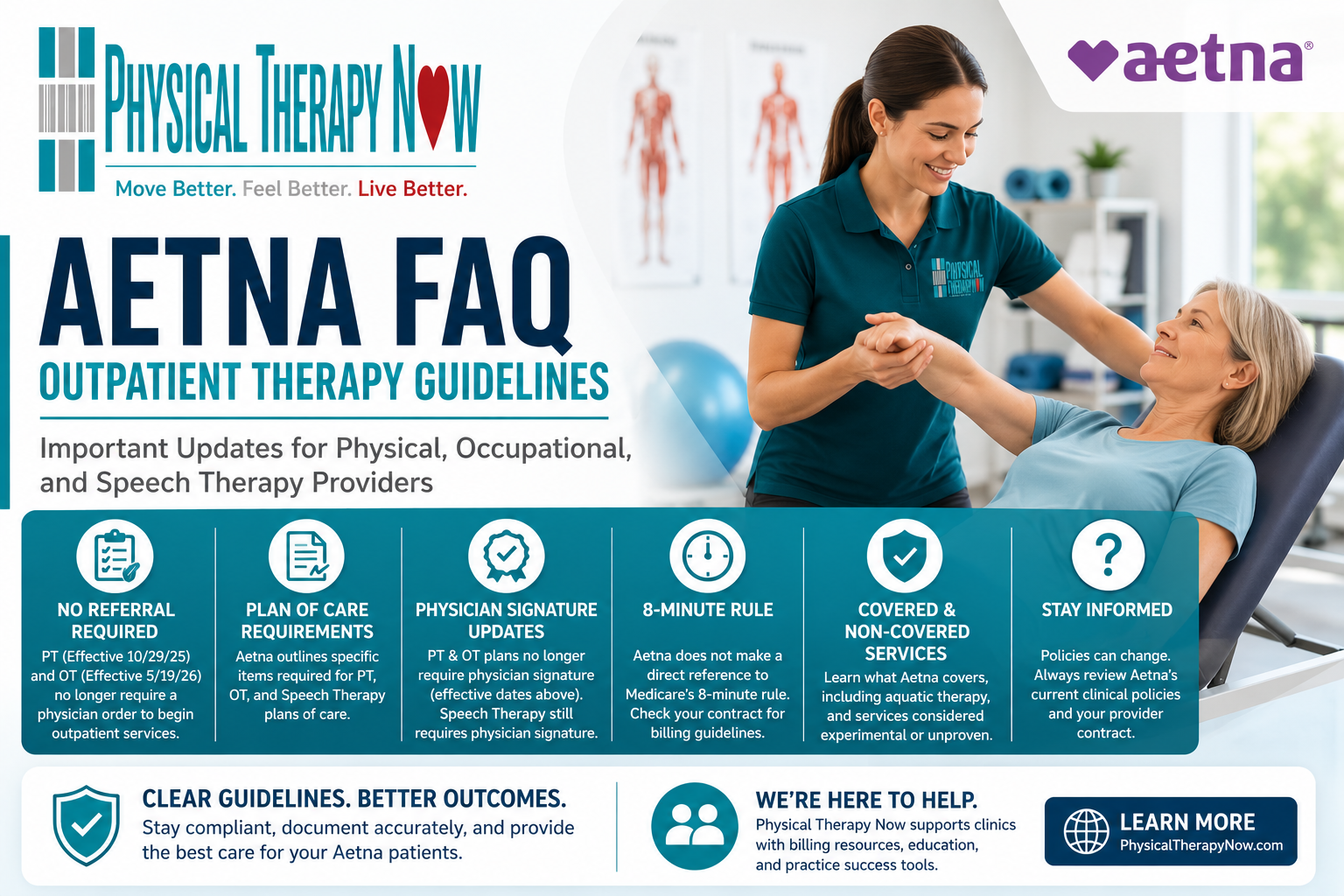
Aetna Outpatient Therapy Guidelines: PT, OT and Speech Therapy
Aetna’s requirements for outpatient physical therapy, occupational therapy, and speech therapy have changed in several important areas, particularly regarding physician orders and plan-of-care signatures. Understanding these requirements is important for rehabilitation providers because the rules are not necessarily identical across PT, OT, and speech-language pathology services. The following overview summarizes key Aetna policies involving referrals, plans of care, timed billing, covered services, and treatments Aetna identifies as experimental, investigational, or unproven.
Aetna Physical Therapy Referral Requirements
Effective October 29, 2025, Aetna no longer requires a physician order for an Aetna member to begin outpatient physical therapy. This allows eligible patients to initiate outpatient PT services without first obtaining a physician’s order, subject to applicable benefit requirements, authorization rules, state law, and the patient’s specific health plan.
Aetna does, however, require the physical therapist to establish an appropriate plan of care. According to the policy information reviewed, the physical therapy plan of care should contain the patient’s diagnosis and date of onset, an estimated timeframe for reaching the established goals, the planned frequency and duration of treatment, and specific long- and short-term goals that are quantitative and objective. The plan should also identify the treatment techniques and exercises that will be used and contain the signature of the physical therapist who established the plan.
Effective October 29, 2025, Aetna also does not require a physician to sign and date the outpatient physical therapy plan of care for an Aetna member receiving outpatient PT.
Aetna Occupational Therapy Requirements
Aetna made a similar change for outpatient occupational therapy effective May 19, 2026. Beginning on that date, a physician order is not required for an Aetna member to begin outpatient occupational therapy.
The occupational therapy plan of care should include the diagnosis, date of onset, quantitative objectives, an estimated timeframe for achieving the goals, frequency and duration of treatment, specific long- and short-term goals, and the treatment techniques or exercises that will be performed. The source policy information also lists signatures of the occupational therapist establishing the plan of care and the patient’s attending physician among the plan-of-care elements.
Importantly, however, effective May 19, 2026, Aetna does not require the attending physician to sign and date the outpatient occupational therapy plan of care. Clinics should therefore distinguish between the information described within Aetna’s plan-of-care documentation requirements and its current physician-signature requirement.
Aetna Speech Therapy Requirements
Aetna’s speech therapy requirements are different. According to its Speech Therapy Clinical Policy Bulletin, Aetna does not state that a physician or other licensed healthcare practitioner must order outpatient speech therapy before services begin.
The speech therapy plan of care should contain the speech therapy evaluation, diagnosis, date of onset or exacerbation, planned frequency and duration of treatment, and specific long- and short-term goals that are objective, measurable, and quantifiable. It should also provide a reasonable estimate of when those goals are expected to be achieved and identify the treatment techniques or exercises that will be used.
Unlike the PT and OT requirements described above, the speech therapy plan of care requires signatures from both the speech-language pathologist who established the plan and the patient’s attending physician.
Does Aetna Follow Medicare’s 8-Minute Rule?
Based on the Aetna clinical policies and resources referenced in the source material, there is no direct statement indicating that Aetna universally applies Medicare’s 8-minute rule to outpatient therapy services.
This distinction is important for therapy billing departments. Clinics should not automatically assume that Medicare’s timed-unit methodology applies to every Aetna claim simply because a CPT code is reported in 15-minute increments.
Providers should review their individual Aetna contracts, reimbursement policies, and applicable plan requirements to determine the correct method for reporting timed outpatient therapy services.
Does Aetna Cover Therapy for Returning an Athlete to Sports?
Aetna distinguishes medically necessary rehabilitation from therapy intended specifically to return an individual to recreational, competitive, or sports participation.
According to the policy information provided, sports-related rehabilitation and similar avocational activities are not considered treatment of disease and therefore are not covered for that purpose. Examples can include rehabilitation specifically directed toward baseball pitching or throwing, cheerleading, golf, martial arts, organized football, baseball, basketball, soccer, lacrosse, swimming, track and field, tennis, dance, competitive weightlifting, and similar activities.
This distinction can be especially important when establishing treatment goals. Rehabilitation addressing a patient’s medically necessary functional limitations may be treated differently from services designed specifically to restore the patient’s ability to participate in a particular sport.
Aetna and Blood Flow Restriction Therapy
According to the referenced Aetna policy information, blood flow restriction therapy is considered experimental, investigational, or unproven.
Physical therapy practices using blood flow restriction techniques should therefore verify coverage and benefits before assuming the intervention will be reimbursed by Aetna.
Virtual Reality Facilitated Gait Training
Aetna also identifies virtual reality-facilitated gait training as experimental, investigational, or unproven according to the source material.
As emerging rehabilitation technologies become increasingly common, providers should distinguish between the clinical availability of a treatment and whether an individual insurance carrier considers that treatment reimbursable.
Driver Training and Occupational Therapy
Driver training is another service with specific coverage limitations. According to Aetna’s Occupational Therapy Clinical Policy Bulletin, driver training is not considered treatment of disease because operating an automobile is not classified as a basic activity of daily living.
Occupational therapy providers should therefore carefully evaluate coverage when treatment is primarily directed toward driving skills or driver rehabilitation.
Does Aetna Cover Aquatic Therapy?
Aetna considers aquatic therapy medically necessary for musculoskeletal conditions under the circumstances described by its applicable coverage policy.
As with other services, medical necessity, documentation, benefit limitations, authorization requirements, and the member’s individual plan should be reviewed before treatment.
Behavioral Vision Therapy and Vision Restoration Therapy
Aetna considers certain behavioral vision therapy and vision restoration approaches experimental, investigational, or unproven.
According to the source policy information, behavioral vision therapy—also referred to as visual perceptual training—is considered experimental, investigational, or unproven for visual perceptual dysfunctions and other indications because Aetna states that effectiveness has not been sufficiently established through well-designed prospective clinical studies.
Vision restoration therapy is similarly considered experimental, investigational, or unproven for visual field deficits associated with conditions such as ischemic optic neuropathy, neurotrauma, or stroke. The policy information also includes vision restoration therapy used alone or in combination with transcranial direct current stimulation for visual field deficits following stroke or neurotrauma.
Speech Therapy Services Aetna May Consider Experimental or Unproven
Aetna’s Speech Therapy Clinical Policy identifies several procedures and indications as experimental, investigational, or unproven because their effectiveness has not been established to Aetna’s satisfaction.
Examples identified in the policy information include altered auditory feedback devices for stuttering and other indications, facilitated communication, the Orton-Gillingham approach when used for speech therapy, speech therapy for chronic cough, speech therapy for post-extubation dysphonia following hospitalization with COVID-19, and transcutaneous electrical nerve stimulation used in speech therapy rehabilitation for voice and swallowing function.
This is not an exhaustive list. Speech-language pathologists and billing personnel should review Aetna’s current Speech Therapy Clinical Policy Bulletin before providing a service when coverage is uncertain.
What Therapy Practices Should Take Away From Aetna’s Policies
Aetna’s outpatient rehabilitation requirements demonstrate why physical therapy, occupational therapy, and speech therapy practices should avoid applying one set of administrative rules across every discipline.
For the policies summarized here, outpatient PT and OT may begin without a physician order, and Aetna has removed physician plan-of-care signature requirements for those services as of their respective effective dates. Speech therapy is different: although the referenced policy does not state that a physician order is required to begin outpatient speech therapy, Aetna requires the speech-language pathologist and attending physician to sign the speech therapy plan of care.
Coverage also varies considerably by treatment. Services such as aquatic therapy may be considered medically necessary under applicable circumstances, while other interventions—including blood flow restriction therapy and virtual reality-facilitated gait training—are identified in the referenced policies as experimental, investigational, or unproven.
Because payer policies can change, outpatient rehabilitation practices should routinely review Aetna’s current Clinical Policy Bulletins, member benefits, authorization requirements, and their individual provider contracts before relying on any coverage or billing rule.
Physical Therapy Now recommends that therapy providers maintain payer-specific billing and compliance procedures rather than assuming that Medicare requirements or another insurer’s policies automatically apply to Aetna.
Ready to start feeling better?
Physical Therapy NOW™ has 40+ Florida locations with same-week appointments. Most insurance, auto accident (PIP), workers' compensation and Medicare accepted.