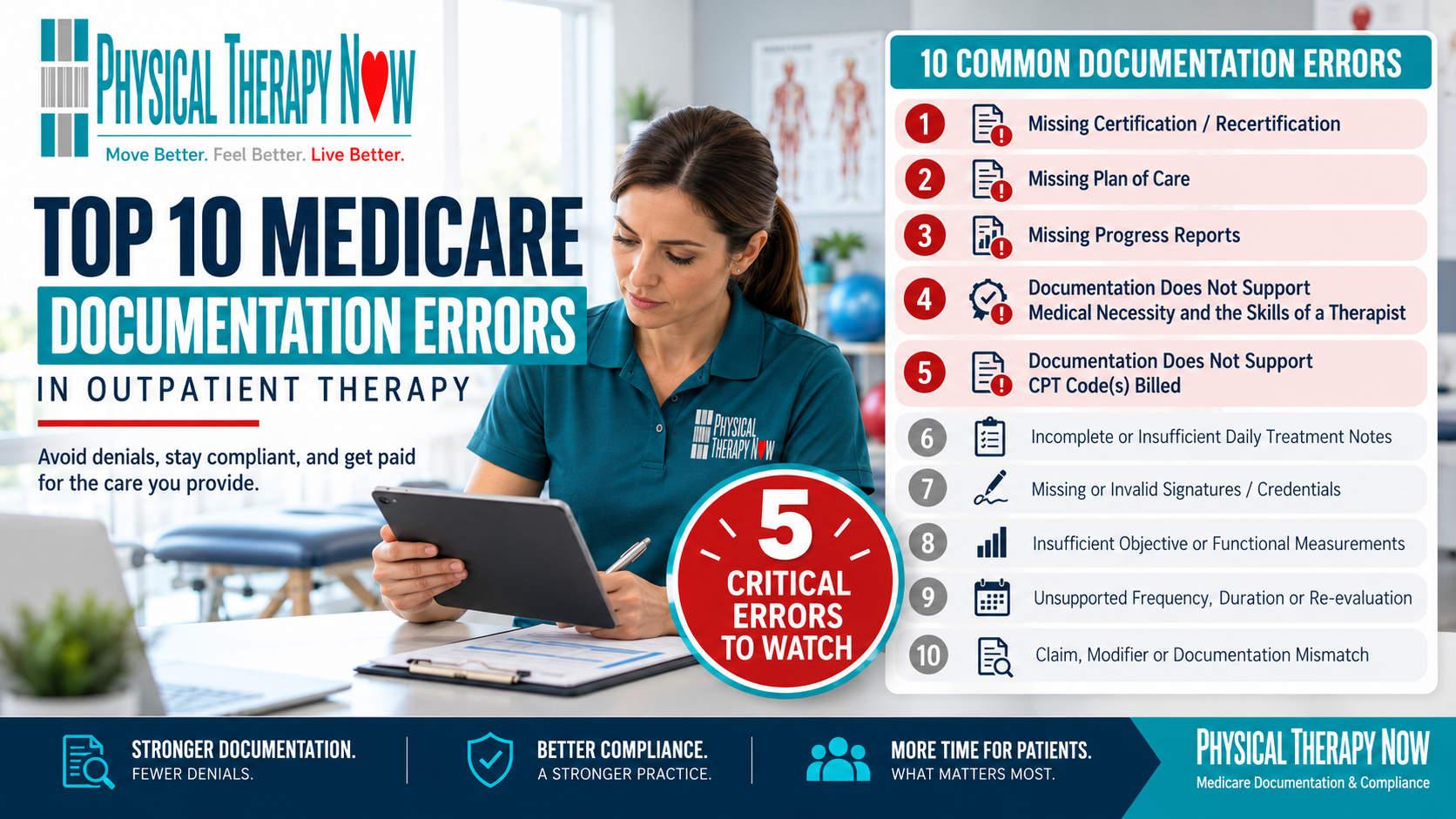
10 Common Medicare Documentation Errors in Outpatient Physical Therapy
By Physical Therapy Now
Medicare documentation is about much more than completing a daily treatment note. The medical record needs to tell a consistent clinical story: Why does the patient need skilled therapy? What is the therapist doing that requires professional skill? Is the patient progressing? And do the services documented support exactly what was billed?
These questions matter. CMS reports that insufficient documentation represented 88.6% of improper payments for physical therapists in private practice during the 2024 reporting period. Another 8.3% involved no documentation, while incorrect coding accounted for 1.5%.
At Physical Therapy Now, we believe strong documentation protects the patient, the clinician, and the organization. Here are 10 documentation problems outpatient therapy practices should watch closely.
The 5 Most Important Documentation Errors
1. Missing or Incorrect Certification and Recertification
Certification remains an important Medicare requirement, but clinics need to understand the current rules rather than relying on outdated processes.
CMS requires the plan of care and appropriate certification documentation to support outpatient therapy services. Recertification is also required when appropriate, including when continued or modified treatment requires it. CMS generally limits a certification interval to no more than 90 days.
A clinic can have the necessary documentation in the chart and still encounter problems if it fails to submit the relevant certification or recertification when Medicare or a review contractor requests the medical record.
Physical Therapy Now Tip: Treat certification tracking as an operational workflow, not simply a therapist responsibility. Your EMR should make upcoming certification and recertification requirements visible before they become compliance problems.
2. Missing or Incomplete Plan of Care
A plan of care is the clinical roadmap for the patient’s therapy episode.
CMS states that a plan of care must include, at minimum, the diagnosis, long-term treatment goals, type of therapy, amount, frequency, and duration. It should also identify the professional who established the plan and when it was established.
A plan of care that exists but is missing required elements can still create a documentation problem.
The treatment subsequently documented should also make sense in relation to that plan. A strong medical record creates a logical progression from:
Evaluation → Plan of Care → Treatment → Progress → Outcome
3. Missing or Incomplete Progress Reports
A daily note is not a substitute for demonstrating meaningful clinical progress.
CMS guidance requires progress reporting at specified intervals, and applicable Medicare coverage guidance commonly requires a clinician’s progress report at least every 10 treatment days or 30 calendar days, whichever is less.
Progress documentation should demonstrate what changed during the reporting period. This includes objective measurements, changes relative to the patient’s goals, an assessment of progress or lack of progress, and the plan for continuing or modifying treatment.
A progress report should answer a simple question:
Why does this patient still need skilled therapy?
If the documentation cannot answer that question, continued treatment becomes more difficult to support.
4. Documentation Does Not Demonstrate Medical Necessity or Skilled Therapy
This is one of the most important documentation concepts in Medicare therapy.
Simply documenting that a patient performed exercises does not necessarily establish that the services required the skills of a physical or occupational therapist.
CMS specifically notes that repetitive exercises that don’t demonstrate a continued need for qualified clinician involvement or teaching may not meet the standard for skilled care. Documentation should demonstrate why the complexity of the patient’s condition requires professional intervention.
For example, instead of merely documenting:
“Patient performed strengthening exercises.”
The record should capture clinically relevant skilled intervention when it occurred, such as therapist cueing, correction of movement patterns, progression or regression of exercises, modification based on symptoms, safety monitoring, response to treatment, functional training, or clinical decision-making.
The objective is not to add unnecessary words. It is to document what made the service skilled.
5. Documentation Does Not Support the CPT Codes Billed
The treatment note and the claim must tell the same story.
If a therapist bills therapeutic activities, for example, the documentation should support the service represented by that code. Likewise, documentation of one type of intervention should not be used to support billing for a materially different service.
CMS states that the medical record and claim must consistently and accurately report the covered therapy services provided.
This becomes particularly important with codes such as:
97110 – Therapeutic Exercise 97112 – Neuromuscular Reeducation 97116 – Gait Training 97140 – Manual Therapy 97530 – Therapeutic Activities 97535 – Self-Care/Home Management Training
Do not select a code simply because it reimburses differently or because it is routinely used by the clinic. The documented intervention must support the code submitted.
Five More Documentation Problems Clinics Should Watch
6. Incomplete Daily Treatment Notes
Every treatment day should have documentation supporting the services delivered.
CMS identifies treatment notes for each treatment day among the records expected to support outpatient therapy.
Daily notes should provide enough information to establish what occurred, how the patient responded, and why the treatment remained clinically appropriate.
Copying nearly identical documentation from one visit to the next can create another problem: the record may fail to demonstrate progression, changing clinical needs, or skilled decision-making.
7. Missing or Invalid Signatures and Professional Identification
A beautifully documented treatment note can still create a compliance issue if Medicare cannot determine who provided or authenticated the service.
CMS requires medical documentation to contain a legible identifier of the person providing the service, and applicable records require appropriate signatures and professional identification.
Clinics should routinely audit electronic signatures, credentials, dates, and authentication workflows.
8. Insufficient Objective and Functional Measurements
Statements such as “patient improving,” “doing better,” or “tolerated treatment well” provide limited evidence of functional progress by themselves.
Objective measurements strengthen the record.
Depending on the patient’s condition, documentation might include range of motion, strength, walking distance, balance measures, functional outcome scores, transfer ability, activity tolerance, pain during specific functions, or other measurable findings.
CMS specifically identifies objective measurements and changes in status relative to treatment goals as important components of progress documentation.
The stronger the objective comparison between the patient’s initial status and current function, the clearer the clinical story becomes.
9. Frequency, Duration, Intensity, or Re-Evaluation Is Not Supported
More treatment is not automatically better treatment.
If a patient’s therapy frequency, duration, or intensity is greater than would ordinarily be expected, the record should explain why.
Likewise, a formal re-evaluation should have a clinical reason. CMS guidance indicates that re-evaluation documentation should provide clear justification, such as new clinical findings, an unexpected change in condition, or failure to respond to the existing plan.
Avoid using re-evaluations simply because a certain number of visits has passed.
10. The Claim, Modifiers, and Documentation Don’t Match
Documentation compliance extends beyond the narrative note.
The CPT codes, units, modifiers, dates, provider information, and medical record need to align.
One particularly important example is the KX modifier. For 2026, CMS states that the KX threshold is $2,480 for PT and SLP services combined and $2,480 for OT services. Using KX represents an attestation that services at or above the threshold are reasonable and medically necessary and that the record supports continued treatment.
Using a modifier correctly therefore requires more than putting it on the claim—the documentation must support why it is appropriate.
The Documentation Test Every Therapist Should Use
Before closing a note, ask:
What changed? What did I do that required my clinical skill? How did the patient respond? How does today’s treatment move the patient toward a functional goal? And does my documentation support every service I am billing?
If another clinician—or a Medicare reviewer who has never met the patient—can read the record and clearly understand those answers, the documentation is much stronger.
Documentation Should Tell the Patient’s Story
Good Medicare documentation isn’t about writing the longest note possible.
It’s about documenting the right information.
The record should show the patient’s problem, establish measurable goals, demonstrate skilled intervention, measure progress, support medical necessity, and correspond with the services submitted for payment.
At Physical Therapy Now, strong documentation and compliance are part of building a scalable rehabilitation organization. As our network grows, standardized clinical and operational systems help our teams focus on what matters most: delivering excellent patient care.
Interested in owning a Physical Therapy Now franchise? Learn more about joining a growing physical therapy brand and building a rehabilitation business with established systems, operational support, marketing resources, and a recognizable brand behind you.
This article is provided for educational purposes and is not legal, billing, or compliance advice. Medicare requirements and contractor interpretations can change. Providers should consult current CMS guidance, their Medicare Administrative Contractor, and qualified compliance professionals for requirements applicable to their practice
Ready to start feeling better?
Physical Therapy NOW™ has 40+ Florida locations with same-week appointments. Most insurance, auto accident (PIP), workers' compensation and Medicare accepted.